



Every Muslim parent wants their child to grow up with a strong connection to the Quran. But figuring out how to teach the Quran to kids at home can feel overwhelming, especially if you are not sure where to start, what age is right, or whether you are qualified to teach it yourself.
The good news is that you do not need to be a scholar to begin your child’s Quran journey at home. With the right approach, a little consistency, and some patience, you can create a foundation that your child will carry for life.
In this guide, we share seven practical tips that parents around the world use to teach the Quran to their children at home, from choosing the right starting point to knowing when to bring in a qualified teacher.
1. Start with Noorani Qaida Not the Quran Itself
One of the most common mistakes parents make is handing a child a Quran before they can read Arabic. This leads to frustration for both parent and child. The Quran is written in classical Arabic, and jumping straight into it without learning the basics is like asking a child to read a novel before they know the alphabet.
Noorani Qaida is the proper starting point. It is a step-by-step guide that teaches children to recognize Arabic letters, understand vowel signs (harakat), connect letters into words, and eventually read short Quranic phrases. Most children who start with Noorani Qaida complete it within 3 to 6 months with regular practice.
If your child can recognize all 28 Arabic letters and read simple words with correct pronunciation, they are ready to move from Noorani Qaida to Quran reading. Wondering when to start? Our guide on the best age for Quran classes can help you decide.
2. Keep Sessions Short and Consistent
Young children have limited attention spans and that is perfectly normal. A common mistake is scheduling long Quran sessions on weekends and skipping weekdays entirely. This leads to forgetting and frustration.
What works better is 10 to 15 minutes every day. Short daily sessions build habit and muscle memory far faster than a one-hour session twice a week. The goal is to make Quran learning part of your child’s daily routine, like brushing teeth, something they do without being asked.
Pick a time that works for your family and stick to it. Many parents find that right after Fajr or just before bedtime works well because the house is calm and there are fewer distractions. The key is consistency, not duration.
3. Create a Calm, Positive Learning Space
Children absorb the atmosphere around them before they absorb information. If Quran time feels tense, rushed, or punitive, your child will associate the Quran with stress. If it feels warm, calm, and encouraging, they will look forward to it.
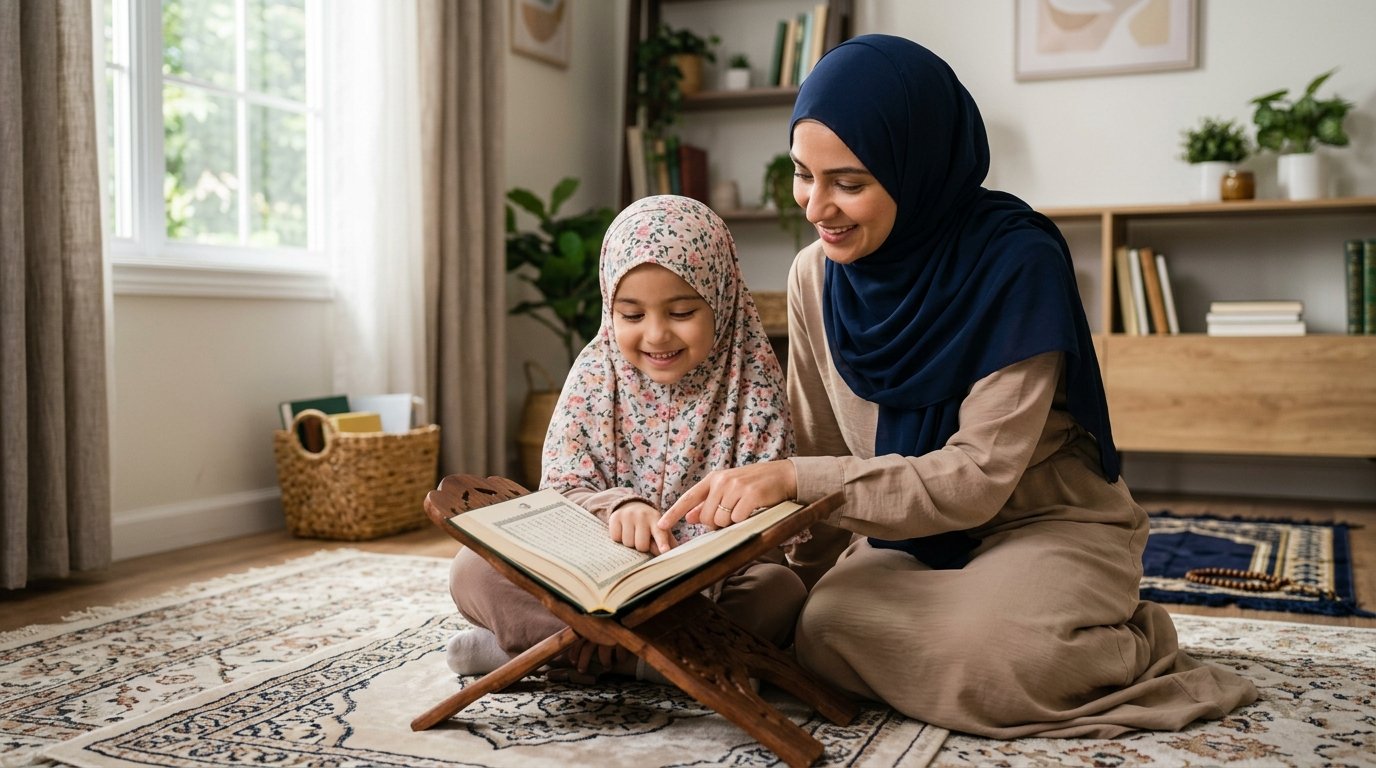
You do not need a dedicated room. A quiet corner with a prayer mat, a Quran stand, and minimal distractions is enough. Turn off screens, put phones away, and give your child your full attention during those 10 to 15 minutes.
Celebrate small wins. When your child correctly reads a new letter or finishes a page, acknowledge it. A simple “MashaAllah, you are doing so well” goes much further than any reward chart. Children who feel safe making mistakes learn faster than children who are afraid of getting it wrong.
4. Learn the Basics of Tajweed Early
Tajweed is the set of rules that govern correct Quran recitation, proper pronunciation, rhythm, and articulation. Many parents assume Tajweed is only for advanced students, but the opposite is true. Teaching the basics of Tajweed early prevents bad habits from forming in the first place.
You do not need to teach your child every Tajweed rule at once. Start with the most foundational ones: correct pronunciation of each Arabic letter from its proper point in the mouth and throat (Makharij). If your child learns to say each letter correctly from the beginning, they will not need to unlearn wrong habits later.
If you are not confident in your own Tajweed, this is where a qualified teacher makes a real difference. A tutor trained in Tajweed can catch pronunciation mistakes that even well-meaning parents might miss, especially the subtle differences between similar-sounding letters like ح and ه, or ص and س.
5. Be a Role Model Recite in Front of Your Children
Children learn by watching more than listening. If your child sees you reciting the Quran regularly, they will naturally view it as a normal, important part of life. If they only encounter the Quran during structured “lesson time,” it becomes a chore rather than a spiritual practice.
The Prophet Muhammad (peace be upon him) said: “The best among you is the one who learns the Quran and teaches it.” (Sahih Bukhari)
You do not need to be a perfect reciter. Let your child see you trying, improving, and valuing the Quran. Play Quran recitation softly at home during meals or before bedtime. Recite together as a family after Maghrib. These moments create a home environment where the Quran feels natural and loved, not just studied.
6. Know When to Bring in a Qualified Teacher
There is no shame in recognizing that your child needs more than what you can offer at home. In fact, one of the best things a parent can do is combine their own home efforts with professional guidance.
Here are signs that it might be time to involve a qualified Quran teacher:
• Your child has finished Noorani Qaida and needs structured Tajweed instruction
• You are not sure if your child’s pronunciation is correct
• Your child is ready to start memorizing (Hifz) and needs a structured revision program
• Your child is losing motivation and needs a fresh teaching approach
• You want your child to learn from someone with formal Quran education (ijazah)
An online Quran teacher can work alongside your home efforts if you continue the daily practice and encouragement, while the teacher provides structured lessons, corrects pronunciation, and tracks progress. This combination of home practice and professional guidance is what produces the strongest results.
7. Be Patient This Is a Long-Term Journey
Quran learning is not a race. Some children pick up Arabic letters in weeks, others take months. Some love memorization, others connect more with understanding meaning. Every child’s journey is different, and comparing your child to others only creates pressure that slows them down.
Set realistic expectations. If your child is 5 years old and learning Noorani Qaida, they are exactly where they should be. If your teenager is starting from scratch, that is also fine, it is never too late to begin. What matters is that learning continues, day by day, without pressure or punishment.
The parents who succeed in teaching the Quran at home are not the ones with the most knowledge, they are the ones with the most patience. Your child will forget verses they memorized last week. They will mispronounce letters they said correctly yesterday. This is normal. Stay calm, stay consistent, and trust the process.
Start Your Child’s Quran Journey Today
Teaching the Quran to kids at home starts with one simple step: begin. Start with Noorani Qaida, keep sessions short, create a warm environment, introduce Tajweed basics early, recite together as a family, and bring in a qualified teacher when your child is ready for the next level.
Your child does not need a perfect parent, they need a present one. The fact that you are reading this article and thinking about your child’s Quran education means you are already on the right path.
At Al Najam Online Quran Academy, we help families continue what they start at home. Our certified male and female tutors work one-on-one with children as young as 4-5 years old, teaching Noorani Qaida, Tajweed, Quran reading, and memorization through live online sessions. You can meet your child’s teacher before the first lesson because we believe trust comes before teaching.
Book a free 5-day trial class and see how our tutors connect with your child. No payment, no commitment, just a chance to experience the difference.