

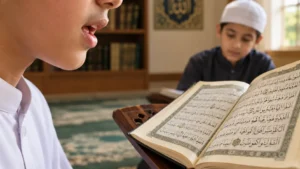

One of the most common questions we hear from parents is: what is the best age to start Quran classes? Some worry they are starting too late. Others wonder if their 4-year-old is too young for structured learning. The truth is that there is no single “perfect” age but there are clear guidelines that help you make the right decision for your child.
In this guide, we break down what Quran learning looks like at every stage from early exposure as a toddler to formal classes for school-age children to starting later as a teenager. By the end, you will know exactly what to expect and when to begin.
Short Answer: Ages 4 to 7 for Formal Classes
Most Quran educators agree that children between 4 and 7 years old are ready for formal Quran classes. But “formal” does not mean sitting at a desk for an hour; it means short, structured sessions with a qualified teacher who knows how to work with young children.
At this age, children can recognize letters and shapes, follow simple instructions, sit for 10 to 15 minutes with guidance, and repeat sounds they hear. These are the basic skills needed to begin Noorani Qaida, the foundation course for learning to read the Quran.
However, the right age depends more on your child’s individual readiness than on a number. A mature 4-year-old may do better than a distracted 6-year-old. The key is watching for signs of readiness, which we cover below.
Once you know your child is ready, our guide on how to teach Quran to kids at home walks you through getting started step by step.
Age-by-Age Guide: What to Teach and When
Ages 0–3: Exposure, Not Instruction
You are not “too early” to start, you are just starting differently. At this age, Quran learning is about exposure, not instruction. Play Quran recitation softly during meals, nap time, or car rides. Recite short surahs while holding your child. Let them see you reading the Quran so it becomes a familiar, comforting part of daily life.
Your toddler will not memorize Tajweed rules, but they are absorbing the sounds and rhythms of Arabic. Research in early childhood development confirms that children’s brains are most receptive to new sounds between birth and age 3. This passive exposure creates a foundation that makes formal learning easier later.
What to do: Play Quran audio daily. Recite short surahs together (Al-Fatiha, Al-Ikhlas). Point to Arabic letters on a poster. No formal classes needed yet.
Ages 4–5: Start Noorani Qaida
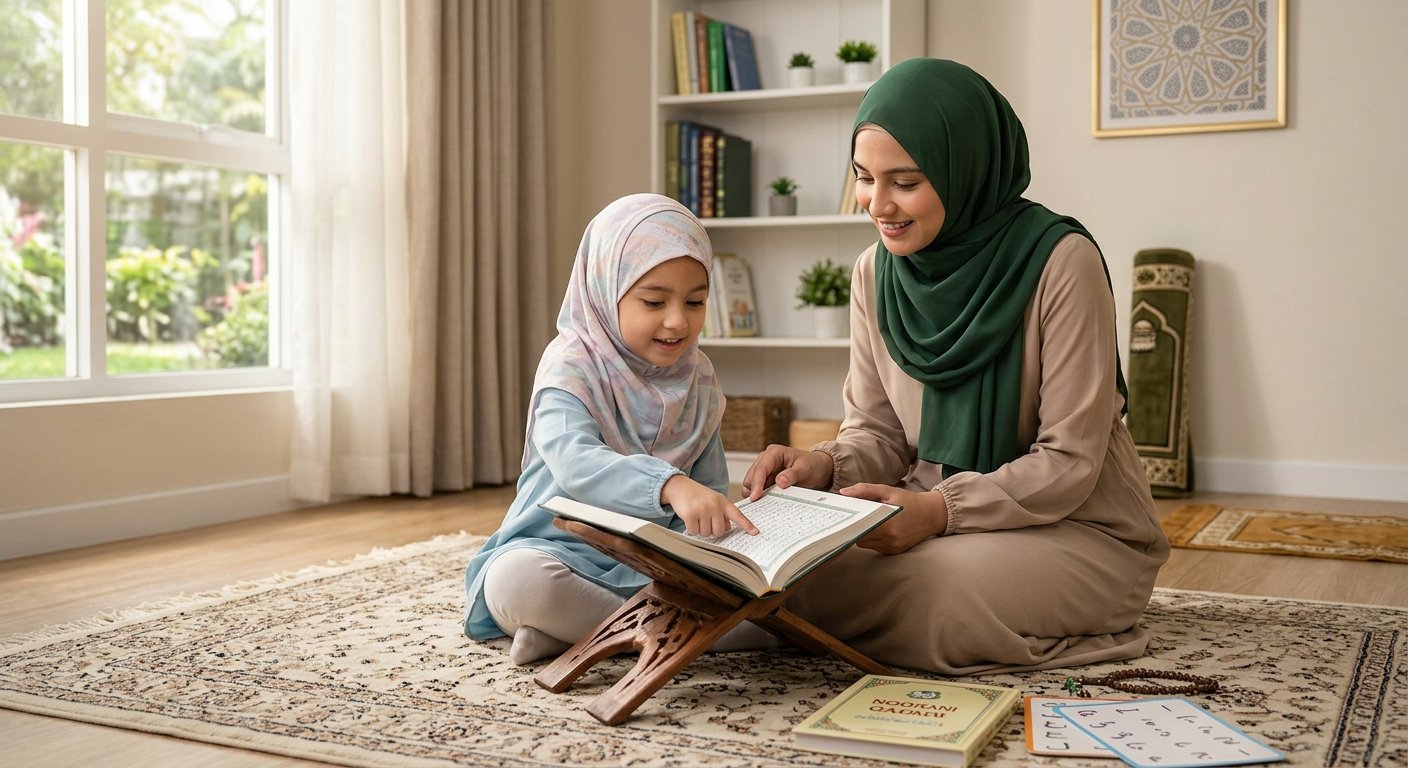
This is when most children are ready for their first structured Quran lessons. At age 4 or 5, children can recognize individual letters, repeat sounds accurately, and follow a teacher’s instructions for short periods.
Noorani Qaida is the right starting point not the Quran itself. It teaches Arabic letter recognition, correct pronunciation from the start, vowel signs (harakat), and how letters connect into words. Sessions should be short 15 to 20 minutes maximum and the approach should be gentle, playful, and encouraging.
At this age, one-on-one classes work much better than group settings. A private tutor can adjust the pace to your child and keep them engaged without the pressure of keeping up with other students.
Ages 6–8: Quran Reading + Basic Tajweed
By age 6, most children who started Noorani Qaida earlier have completed it and are ready to read directly from the Quran. This is also the age when basic Tajweed rules can be introduced starting with proper pronunciation points (Makharij) and simple rules like Ikhfa and Idgham.
Children at this stage can handle 20 to 30 minute sessions, 3 to 5 times per week. They have the focus and memory to start building real reading fluency. Many families find this is the natural time to move from parent-led home practice to regular classes with a qualified Tajweed teacher.
This is also the most common age for starting Hifz (memorization). Children who have a strong reading foundation and show interest in memorization can begin a structured Hifz program around age 6 to 8. Early starters often progress faster because their memory capacity is at its peak.
If your child is ready for Tajweed, our certified tutors teach correct pronunciation and recitation rules through live one-on-one sessions.
Ages 9–12: Deepening Understanding
At this age, children can handle longer sessions, more complex Tajweed rules, and begin to appreciate the meaning behind what they recite. This is a good time to introduce Tafseer (Quran explanation) alongside recitation helping your child connect the Arabic they read with its message.
For children who started Hifz earlier, ages 9 to 12 are when consistent daily revision becomes critical. For those just starting formal Quran classes at this age, there is no need to worry they can still learn Noorani Qaida and progress to fluent reading. The timeline is simply compressed because older children learn faster.
Ages 13+: It Is Never Too Late
If your teenager has not started Quran classes yet, do not let guilt stop you from enrolling them now. Teenagers learn Arabic letters and reading skills much faster than young children because their cognitive abilities are more developed. What might take a 5-year-old six months could take a motivated 14-year-old eight to ten weeks.
The challenge with teenagers is not ability, it is motivation and self-consciousness. Many feel embarrassed starting from scratch. A private one-on-one class removes this barrier entirely: no classmates, no comparison, no judgment. Just a patient teacher and a student building a skill they will carry for life.
5 Signs Your Child Is Ready for Quran Classes
Age is a guideline, but readiness matters more. Your child is probably ready if they show these signs:
1. They can sit and focus for 10-15 minutes. They do not need to sit still for an hour just long enough for a short, structured lesson.
2. They can follow simple instructions. If they understand “repeat after me” or “point to this letter,” they can follow a Quran teacher.
3. They recognize shapes and patterns. Arabic letters are shapes. If your child can tell the difference between a circle and a square, they can learn to tell the difference between ب and ت.
4. They show curiosity about the Quran. If they ask what you are reading during prayer, try to imitate Quran recitation, or want to hold the Quran that curiosity is readiness.
5. They can repeat sounds they hear. This is the most important one. Quran reading starts with hearing a sound and repeating it correctly. If your child can do this with any language, they can do it with Arabic.
If your child shows 3 or more of these signs, they are ready regardless of whether they are 4 or 8.
What If You Feel Like You Started Too Late?
This is worth addressing directly because so many parents carry unnecessary guilt about this. If your child is 8, 10, or even 15 and has not started Quran classes, you have not failed them. You are thinking about it now, and that is what matters.
Children who start later actually have some advantages. They learn the mechanics of reading faster because their cognitive skills are more developed. They can understand explanations that younger children cannot. And they can build a practice habit more independently.
The only real disadvantage of starting later is in memorization younger children’s brains are wired for rote memorization in a way that older children are not. But even this can be overcome with consistent daily practice and a structured revision program.
The worst time to start is never. The best time to start is now.
Help Your Child Start at the Right Time
The best age to start Quran classes depends on your child, not a number. Early exposure through listening and family recitation can begin from birth. Formal structured classes starting with Noorani Qaida are appropriate for most children between ages 4 and 7. And if your child is older, they can still learn quickly and build a strong foundation.
What matters more than age is consistency, patience, and finding a teacher who connects with your child. Short daily sessions with a warm, qualified tutor produce better results than occasional long sessions with an impatient one.
At Al Najam Online Quran Academy, our certified tutors work with children as young as 4-5 years old, as well as teenagers and adults starting from scratch. Every student learns one-on-one, at their own pace, with a male or female teacher matched to their needs. And you can meet your child’s teacher before the first lesson because we believe trust comes before teaching.
Book a free 5-day trial class and let your child experience what learning the Quran with the right teacher feels like.